Chemical inventory of hazardous substances: what it is, what it’s for, and how to create one using SDSs
How to transform the information contained in Safety Data Sheets a database that can be used for audits, chemical risk assessment, compliance, and sustainability
In many companies, information on hazardous substances already exists. It is contained in the Safety Data Sheets from suppliers, in Excel files compiled over time, and in folders shared across departments and facilities.
The problem is that when you need to know:
“New substance on the Candidate List: do we have any products that contain this substance?”
“Are we using substances that are on the lists of substances prohibited or restricted by regulations or by our customers?”
“Are the SDSs we’re consulting up to date?”
The answers shouldn't require extensive searches through scattered documents, different versions of the same SDS, and archives that are difficult to update.
This is precisely wherethe chemical inventory of hazardous substances comes into play: an essential tool for transforming scattered data into reliable, easily searchable information that can be used to address safety, regulatory compliance, and sustainability needs.
What is a chemical inventory of hazardous substances?
A chemical inventory is a structured collection of data on hazardous substances and mixtures present in the workplace.
This is not a periodic report or a list of chemicals for physical inventory purposes, but a comprehensive and organized database that allows you to identify and retrieve key information such as:
manufacturer/supplier
name of the substance or mixture
CLP classification
H and P phrases
hazard symbols
CAS, EC, and Index numbers
components of the mixtures and their concentration ranges
additional data useful for regulatory compliance reviews, audits, and internal controls
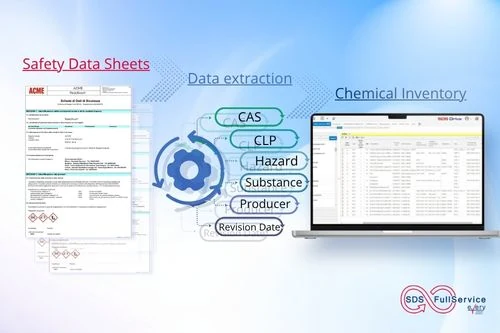
When this (and other) data is extracted from SDSs and centralized in a digital system, it becomes truly usable: it can be searched, filtered, compared, cross-referenced with lists of substances, and used for reporting and timely decision-making.
In essence, the digital chemical inventory is the“official map” ofthechemicalsacompany uses: without this map, it is impossible to manage HSE risks, product sustainability, and impacts within the supply chain.
Why create a chemical inventory based on SDSs
SDSs are the primary source for compiling a reliable chemical inventory.
They already contain much of the information needed to identify products, assess their hazards, understand their composition, and verify the most relevant regulatory requirements. The point, therefore, is not to collect data from scratch or build a parallel system for manual entry, but to transform the content of the SDSs intodigital data that can be used over time.
Starting with the SDS means:
make the most of the information already available
avoid redundant manual entries
reduce transcription errors
additional data useful for regulatory compliance reviews, audits, and internal controls
Why Excel, network folders, and PDFs are no longer enough
In practice, many companies start by creating a shared folder to store the SDSs they receive from suppliers. Then, to keep track of things more effectively, they create an Excel spreadsheet or a SharePoint site containing a list of products and some key information.
It might work at first.
Over time, however, the same problems almost always arise:
duplicate documents
Outdated SDSs still in circulation
New versions that haven't been updated anywhere
difficulty in knowing which products are actually in use
lack of a unified view across different departments, facilities, or countries
The result is that the information exists, but it remains scattered. And when it’s needed, you have to piece it all together from scratch every time.
What is the purpose of a well-structured chemical inventory?
The chemical inventory of hazardous substances is used to support activities within companies that have a direct impact on operations, risk, and compliance.
Chemical Risk Assessment
To properly assess chemical risks, reliable data is needed on the substances in use, their hazard classifications, the components of mixtures, and their concentrations.
If this information has to be searched for manually in the SDSs, the process slows down and becomes more prone to errors. With a structured chemical inventory, however, the data is already available, can be quickly accessed, and can be easily integrated with other company data needed for risk assessment.
Monitoring of Critical Substances
The substances present in the company change, new products are introduced, new SDSs arrive, classifications are updated, and the lists of prohibited substances or those with restricted use are constantly updated: ECHA, industry-specific MRSLs, customer lists, CMR substances, and other public or private lists. A structured chemical inventory allows you to automatically cross-reference the substances in the inventory with these lists, receive real-time alerts, and prioritize attention on the most critical products and/or those with higher risk profiles.
Audits, inspections, and customer requests
During audits, internal reviews, or requests from clients and certification bodies, the ability to respond quickly with accurate and verifiable data makes all the difference.
Management of SDS Revisions
When a new version of an SDS is released, simply filing it away isn’t enough. You need to quickly determine whether it contains significant changes, where the product is used, and who needs to assess its impact.
A structured chemical inventory helps ensure the continuity of this process.
Sustainability and ESG Reporting
Increasingly, information about the chemicals used in manufacturing processes also has an impact on sustainability, the supply chain, certifications, and ESG reporting.
For this reason, the chemical inventory is not limited to the HSE and Regulatory departments; rather, it serves as a valuable information resource for various business functions.
How to Compile a Chemical Inventory Correctly
Building a reliable chemical inventory requires a systematic and structured approach.
The first step is to gather the SDSs already on file at the company. Next, you need to review the existing archive, remove duplicates, identify obsolete documents, and request any missing or updated SDSs from suppliers.
Only after this phase does it make sense to proceed with thedigitalization dataandthe creation of acentralized database.
It is clear that, even with just a few hundred SDSs, a structured and automated process is needed simply to “clean up” the initial document archive.

How to keep it up to date
A chemical inventory cannot be considered a one-time project.
New SDSs are being issued, suppliers are updating their documents, classifications are changing, lists of substances are evolving, and the products in use may vary by site and department.
To ensure its reliability, the chemical inventory must therefore be maintained over time by:
acquisition of the new SDSs
Revision update
collaboration with suppliers to verify data quality
ongoing comparison with regulatory or industry-specific lists
distribution of up-to-date information to interested users
SDS-FullService’s contribution to chemical inventory management
At every stage of SDS management—from the initial creation of a chemical inventory to its ongoing updates—SDS-FullService helps companies transform a complex, often fragmented, and costly task into a structured, traceable, and manageable process.
The platform automates and provides specific features for collecting, sourcing from suppliers, and centralizing SDSs; it enables users to identify and eliminate duplicate documents, retire obsolete ones, digitalize , and manage approval workflows. In addition, it allows users to monitor substances against public and private “watch lists” and make up-to-date information available to all authorized users.
In this way, SDS-FullService simplifies all tasks related to creating and updating chemical inventories, while also providing traceable and verifiable reports and data for internal reviews, customer audits, or third-party inspections.
Chemical inventory: the true value
The true value of a structured chemical inventory lies not only in simplifyingcompliancewitha complex regulatory framework that is often difficult to implement.
Above all, it lies in the ability to findreliable answers when you need them.
Knowing quickly whether a particular substance is present on-site, whether a product requires attention, whether an SDS is up to date, whether a mixture is affected by a critical list, or whether an audit can be conducted using solid, verifiable data is not merely an operational benefit.
It means working with greater peace of mind, knowing thatcritical information about chemicals is up-to-date, accessible, and under control. But above all, it means adopting a practical approach to managing risk, protecting people and the environment, and strengthening business continuity.
Our team is here to help you on your path to Digital Transformation