I was right about the what. Not about the when.
2006–2026. Twenty Years of Every Software Solutions: an Interview with Roberto Di Martino, Founder and CEO
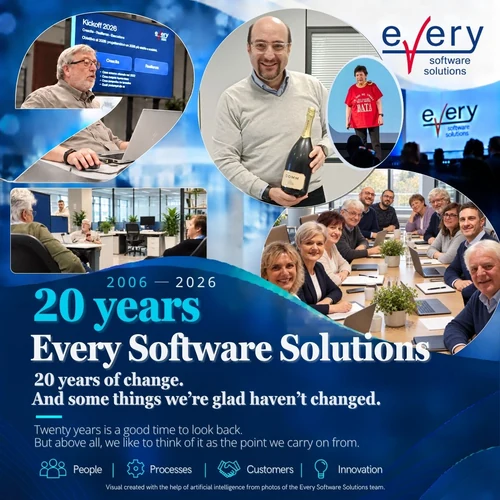
On November 1, 2006, Every Software Solutions launched its operations, based on a bet made by its founder, Roberto Di Martino: that software would evolve from a product into a service. Twenty years later, we asked him what went as planned, what didn’t, and what’s next.
THE BET
November 2006. Every was founded with a vision that, at the time, seemed like a gamble: “Cloud and SaaS will eventually replace software licenses.” What did you see coming?
Back then, software was almost always a product: customers would purchase a license, install it on their own servers, and handle its maintenance and updates. I was convinced that this model was bound to change. I wasn’t interested in the cloud itself, but in what it made possible: no longer owning the software and instead using it as a service—always up-to-date and available, capable of growing and evolving alongside the company.
Back then, the most common objection was about the cost: our annual subscription fee was about one-third the price of a license. And to many, the math seemed simple: “In three years, I’ll have paid as much as the license plus two years of maintenance—and then I’ll keep paying?” But they were comparing different items. The subscription fee also included everything that remained a hidden cost in the traditional model: infrastructure, backup, functional and technological upgrades, 24/7 availability, ongoing support, and security measures.
Another common objection was: “What if I don’t have Internet access?” Today it makes us smile, but back then it wasn’t just skepticism: for a long time, it was a real limitation. There were entire factories connected via Internet connections that were slower and less stable than those available today with any home Internet plan costing just a few euros a month. That question disappeared about ten years ago.
Then there were the fears: that we might see their data, that we might lose it, that the service might go down—and, with it, their work.
And it wasn’t easy to talk to the big IT and telecommunications companies either—potential partners who were also looking for cloud solutions to offer. We envisioned a single platform shared by all customers; the model they had in mind was one server per company. In 2008, IBM’s international “SaaS Specialty” program certified our solution at the time, which we had redesigned to serve many customers with a single installation. We were the first in Italy to obtain that certification. While we were struggling here to explain our architecture, the international market was moving precisely in that direction.
Essentially, the vision was this: instead of purchasing licenses and running the software on their own infrastructure—which they would have to maintain, update, replace, and… manage—companies would increasingly purchase access to a service that includes everything needed to use it. “Software as a Service,” in other words.
What part of that prediction did you get wrong?
On the what, I was right: the cloud has taken the forms I imagined, and the beliefs I held back then have been confirmed by the facts.
On the when, no… I was way off! I thought it would take three to five years to reach a point where our revenue consisted mainly of cloud services. It actually took twelve to fifteen years.
In the past, I’ve had other instances where I anticipated a trend well in advance and misjudged the timing by margins like these. But getting there early has a major advantage: when the market actually changes, you arrive with more mature experience and solutions than those who come later. For a company of our size, this is essential: it’s how you become recognized as one of the reference players in your specialization.
TWENTY YEARS ON THE ROAD
Was there ever a moment when you were afraid you wouldn't make it?
Yes, in the years following the 2008 crisis—years in which we lost a significant portion of our revenue. That was the only time we truly felt fear: medium-sized Italian companies, which were our market at the time, were at a standstill, in a sort of decision-making paralysis. They were only deciding what and where to cut back. The impact was twofold: customers were scaling back their traditional operations and postponing more strategic decisions.
We came through it with radical decisions and thanks to all our people, who demonstrated a great sense of responsibility and belonging during the most difficult times.
We strengthened our technological capabilities and invested more in the solution. Then we shifted our focus to large companies. But a company like ours can’t break into a large enterprise with a general-purpose offering—we needed to specialize. And a client pointed us in that direction.
Which specialization? And why that one in particular?
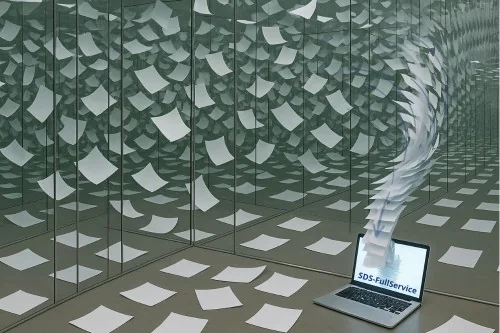
In 2011, a company that was already using Share, our platform for digitalizing supply chain exchanges, asked us to configure it to distribute SDSs, or Safety Data Sheets. These are the documents that accompany hazardous chemicals, and current regulations require them to be delivered in a strictly controlled and traceable manner. We quickly realized that this was a serious issue, yet one that even large companies were not yet adequately addressing. That’s how SDS-Delivery was born.
Then we realized that for every company that distributes SDSs, there are thousands of customers who need to receive, archive, consult, and keep them up to date. SDS-Drive was created for them. Later, a major industrial client made us realize that it would be very useful to automatically convert documents into data, and in 2016 we co-founded ChemParser, a company dedicated solely to this task, which remains our key partner to this day. Today, all of this—and much more—is SDS-FullService.
It seems like things just happen by chance. In reality, that’s how we work: we’re very client-driven, but when someone tells us about a need, we never view it as a custom project. We try to see it as a standard solution that we can offer to the entire market. It’s all about connecting the dots, and those dots are our clients’ requests. Virtually all of our solutions have been created and developed this way.
And it’s still happening today: this year, a company asked us for a solution to manage Seveso III requirements. We designed it as a standard solution, and other clients are already asking for it even before we’ve introduced it to the market.
In the software industry, economies of scale are achieved by the big players. Every has taken a different path: Is this a choice or a limitation?
A choice that also comes at a cost.
We have never measured growth by the number of people: for a company like ours, what matters are skills and specialization. A close-knit structure brings together those who identify a need, those who design the solution, and those who then develop it further.
The trade-off is that certain burdens do not decrease with size. Security and compliance require the same level of commitment from us as they do from a much larger company: the same audits, certifications, and regulatory obligations. But this is also what our customers expect from us.
In a sense, we do have economies of scale after all: they lie in the architecture. That’s precisely the idea from 2006—the one that potential partners didn’t understand: a single infrastructure, a single software solution—Share—shared by all customers and configurable without customization. Any requirement that becomes a standard can immediately serve everyone, and the amount of work required does not increase proportionally with the number of customers. For eight years, more than half of our revenue has been recurring, and today we’re close to 80%. This revenue is renewed every year because customers continue to use our solutions. And over the past three years, all new contracts have come from companies that reached out to us on their own.
People and customers who stick around for twenty years. Isn't there a risk of getting used to it?
With clients, it’s almost impossible to get used to things: they’re constantly changing. At many of the client companies we’ve been working with for years—sometimes since the very beginning—there have been changes in ownership, CEOs, IT managers, and purchasing directors. In some cases, none of the people we started out with are still there, and each time we have to earn the trust of the newcomers all over again.
We, on the other hand, are a constant, for them too, and that is thanks to our people: many of our employees have been with us from the very beginning. Their value lies not in their seniority, but in the fact that they have evolved alongside the company, embracing new technologies, products, and markets. It’s one of the things I’m most proud of.
The awards we value most are the ones we’ve shared with our clients: in 2013, Borbonese received the Best Cloud Award for the project carried out with Share; in 2024, the SDS-FullService project with E.Miroglio won the Sustainability Award at the Digital360 Awards.
TODAY, AND THE NEXT TWENTY YEARS
Has the way companies evaluate and purchase software solutions also changed?
A great deal—it has changed a great deal.
If I had to summarize what we see in negotiations: until a few years ago, we spent perhaps 80% of our time discussing the solution—its functionality, processes, how it would be used, and, of course, costs. Security, compliance, and contractual issues were part of the discussion, but they took up a much smaller portion of it.
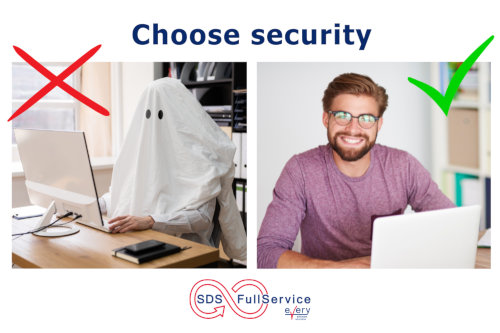
Today, especially when working with structured organizations, the ratio has practically reversed. Roughly 30% of the pre-sales process focuses on the solution, while the remaining 70% is devoted to security, compliance, privacy, and legal issues.
This doesn’t mean the product has become less important. It means that a company no longer evaluates just what a solution does, but also how it is delivered, how data is protected, what requirements it meets, and what guarantees the provider can offer over time. And even a signed contract is no longer the end of the story: customer policies and regulations change, and we adapt accordingly.
What about the concerns from 2006 regarding the data? Do they still exist?
Yes, but they’ve changed in nature. The fears of those days (that we might see the data, lose it, or that the service might go down) now have names: confidentiality, integrity, and availability. And they’ve become requirements that companies verify. Our Information Security Management System has been ISO 27001 certified since 2021, and in 2025 Italy’s National Cybersecurity Agency (ACN) included us among the important entities under the NIS 2 legislation, with the resulting security obligations.
Twenty years ago, the game-changer was the cloud; today, it’s artificial intelligence. What really changes with AI? And what wouldn’t you entrust to it?
The cloud has changed the way software is deployed, used, and updated. Artificial Intelligence is changing software itself—how it is developed and maintained, as well as what it is capable of doing. Those who delay adopting AI risk giving their competitors an advantage that will be difficult to overcome.
Internally, we adopted it early on: after a pilot phase that lasted throughout 2023, in early 2024 we enrolled all our employees in a training program—the Every SWS AI Academy—and today AI is a working tool across all areas of the company. We’re introducing it into our solutions more gradually: some features are already available to customers, but in certain contexts, AI still requires caution.
For me, it’s a tremendous enhancer of human capabilities: it saves time—sometimes dramatically—but above all, it improves the quality of the results. On one condition: that the AI works as part of a team with someone who is knowledgeable about the subject. Knowledgeable, not presumptuous.
This interview, too, was the brainchild of our Marketing & Communications team, and I edited it with the help of an AI. But the facts and opinions are my own: the AI helped me organize them and put them into writing in one-tenth of the time it would have taken me to do it on my own. And, there’s no denying it, it provided me with quite a few ideas. I ran with some of them and not others.
That’s why I believe that in 2026, anyone leading a company—whether an owner or a manager—will need to “roll up their sleeves” and use AI directly, just as they did early in their career, by getting involved in day-to-day operations, walking the factory floor, and meeting with customers. Delegating this task to someone else who uses AI in their place means giving up what makes it effective: their own expertise.
What I wouldn’t entrust to AI are autonomous decisions—made without prior discussion and without defining the scope within which it can act. And strategic decisions—those where intuition and the responsibility to choose matter—still require a human touch.
What is the common thread linking the 2006 Every to the 2026 Every? And where do you see it in twenty years?
The constant is certainly trust in technology, coupled with a certain wariness of the complexity that holds innovation back.
Behind a simple solution can lie a great deal of technological complexity: our job is to manage it ourselves, not pass it on to the client. When a solution works well, the user can focus solely on their work. Over the past twenty years, the tools have changed—from the cloud in 2006 to today’s AI—but our focus has remained the same: to take a client’s need, understand it thoroughly, and deliver it to everyone as a simple solution.
I don’t know where we’ll be in twenty years. But I’ve learned one lesson: this time, I’ll only make predictions about the what.
Back in 2006, I said that companies would stop buying drills and start renting them. In twenty years, I think, they won’t even want that anymore: they’ll just want the hole. Someone will have to take on all the complexity behind it—and we’d like to keep doing that.
As for the when… let’s talk about it again in twenty years.